Microsoft's Product Insights was a new application withing the Dynamics 365 Suite designed to help organizations collect and unify customer data across web and mobile channels, comparable with Google Analytics and Adobe Anlaytics.
The platform had powerful capabilities, but early user testing revealed a critical gap: customers couldn’t fully engage with the product during onboarding and struggled to understand its value.
Setup was confusing and required database permissions many users didn’t have, creating delays and friction that stalled adoption. I was brought in to redesign the onboarding experience, not just to simplify the interface, but to remove barriers to activation and help users experience meaningful value within 5 seconds.
The initial user tests of the onboarding flow failed to pass the monthly business review with the GM of Dynamics 365. After progressing through five screens, users landed on an empty state with nothing to do. They had completed work, but experienced no payoff.
The activation path required too much manual input, too many steps, and delivered no immediate value. It missed the internal “5x5” benchmark: wow within 5 seconds, investment within 5 minutes.We needed to transform onboarding from a procedural checklist into a compelling first experience.
Early research focused on the core questions key users (data analysts) were trying to answer:
Competitor analysis revealed strong AI positioning and polished dashboards, but many tools still required significant setup before delivering value. The opportunity wasn’t just better analytics, it was faster realization.
The original design required users to
So, they did the work, but didn't get the pay off.
I partnered with Microsoft Research team to deepen persona understanding and led a user scenario writing workshop with the design team, a previously overlooked phase in the product process. Together, we mapped scenarios aligned to strategic goals.
From there, I applied three onboarding principles informed by years of UX research and working with subject matter experts in learning science:
Instead of a traditional Microsoft-style feature tour, I designed a personalized, story-driven experience. I used active learning techniques, prompting users with real questions they care about, encouraging interaction, and stimulating engagement rather than passive consumption.
To eliminate dependency on internal data teams, I connected a fully interactive sample database directly into the onboarding flow.This allowed users to:
Engagement could begin instantly.
Instead of landing on an empty dashboard, users encountered a meaningful narrative:
The home experience became an activation engine, not a holding page.This foundation enabled the broader team to confidently conceptualize navigation, reports, and settings — preparing the product for Public Preview and community feedback.
Rather than taking the usual Microsoft linear feature-by-feaure tour approach, I designed the experience around inquiry, surfacing relevant business questions to let the user uncover the answer through interaction
Research shows that when users are actively involved, they process information faster and retain it longer, a principle that applies just as much to product onboarding as it does to the classroom.
For Product Insights, I designed the experience around real business questions. Instead of explaining features, we prompted users with the problems they’re trying to solve, told a story aligned to their goals, and offered multiple paths to explore the answers
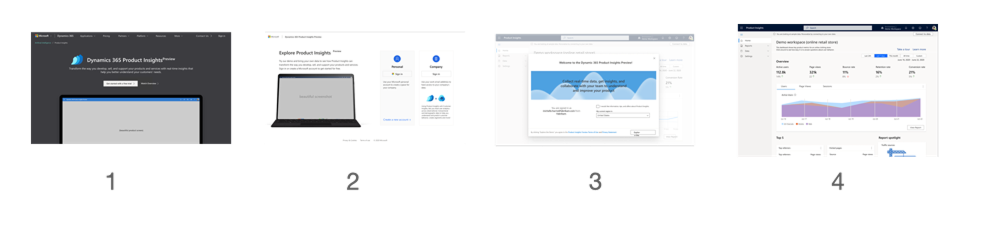
Seven screens of setup created hesitation and drop-off. By reducing the flow to four simple, purposeful steps, we shortened time-to-value and made onboarding feel achievable instead of overwhelming.

The original experience ended in an empty state that stalled momentum. The redesigned home experience replaces emptiness with relevant demo data and guided questions, turning onboarding into the first moment of real product use.
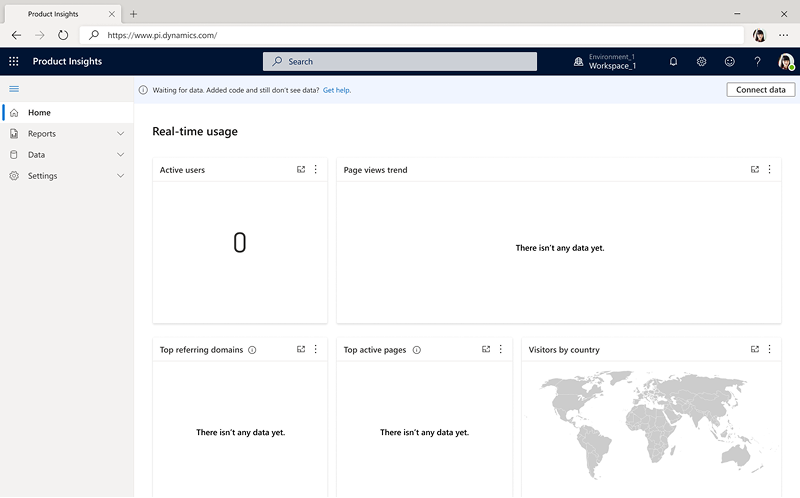
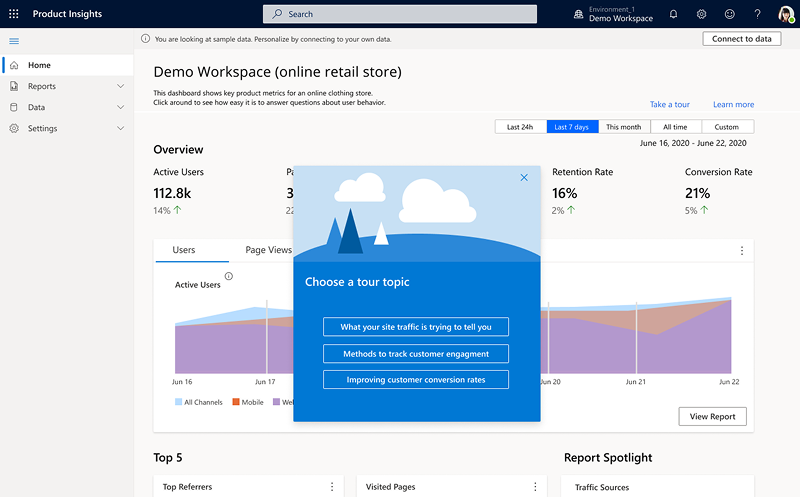
The redesigned onboarding flow eliminates unnecessary setup and guides users quickly into the product experience. Interactive demo data and question-driven prompts help new users start exploring insights immediately.
The redesigned onboarding experience transformed first impressions from procedural to purposeful. Users no longer felt stalled by setup. They engaged immediately, explored insights, and understood the product’s value within minutes.Internally, the work reset the product direction. It established the experiential standard for the rest of the platform and positioned Product Insights for Public Preview readiness.
As one user test participant put it:
“Oh! This would make my weekly reporting so much easier, having it all in one place like this."
Most importantly, the product moved closer to achieving its 5x5 benchmark — proving that value delivered quickly is value remembered.
.svg)
