After more than a decade leading in higher education, Localist (a platform for creating and managing white-label community event calendars) faced a rapidly changing market. Nearly half of its competitors had emerged in just three years. To keep growing, Localist needed to move beyond its core audience. Nonprofits stood out as a strong next segment: mission-driven, community-focused, but with distinct needs and workflows. This wasn’t just a growth opportunity, it demanded a meaningful evolution of the product.
Localist’s platform facilitated events effectively, but lacked a structured analytics layer to demonstrate measurable impact. Without deeper insights, nonprofits couldn’t justify investment.
Since we didn't know exactly what metrics were prioritized by our main customers, this meant starting with user research to get a better understanding of the needs of each cohort.
Our initial interviews indicated that while most customers shared a commitment to community building, they measured success a bit differently. Higher education institutions prioritized event discoverability, accessibility, and brand alignment while nonprofits valued attendance growth, chapter engagement, volunteer activation and community health metrics.
The product enabled event creation and management, but stopped short of showing performance. For nonprofits, especially those with distributed volunteer-run chapters, attendance data was fragmented, engagement metrics were unclear and community growth was difficult to measure. Event organizers were manually compiling spreadsheets or relying on anecdotal feedback.
I kicked off with a stakeholder alignment workshop using affinity mapping to clarify what we believed about our customers behavior and needs, which problems were worth solving and which segment of customers to include in our user interviews.
Our research plan focused on three questions:
Over a period of two weeks, I conducted 10 semi-structured interviews. Using low-fidelity wireframes and interactive prototypes, I tested streamlined flows early, validated session nesting structures and reduced unnecessary configuration steps.
In sum, our hypothesis was validated. A feature that gives access to actionable event insights would directly influence retention, funding, and strategic planning and therefore would be valuable to our key customers.
Rather than introducing a complex analytics dashboard immediately, I designed a lightweight but powerful engagement feedback system which was quick to deploy and could deliver insights in a familiar format, within the existing infrastructure. This allowed us to learn quickly, validate value with real users, and iteratively evolve toward a more robust, closed-loop insights system.
A critical factor in our success was close collaboration with engineering to architect a solution that leveraged existing system components. Given resource constraints and the absence of a mandate for full-scale refactoring, I focused on extending the current framework rather than overhauling the core architecture. This approach allowed us to introduce new functionality without destabilizing dependent workflows or creating regression risks within the broader product ecosystem.
We introduced important new functionality and utilized best practices to make the user experience feel as intuitive as possible, including: parent-child conference framework, nested session builder, progressive disclosure UI and conference website templates.
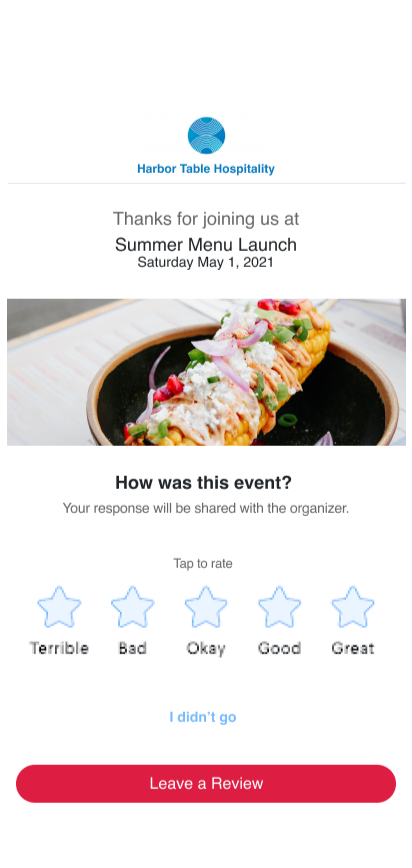
Attendees can share quick feedback right from the email or return later to complete a more detailed form—making it easy to respond when it works for them.


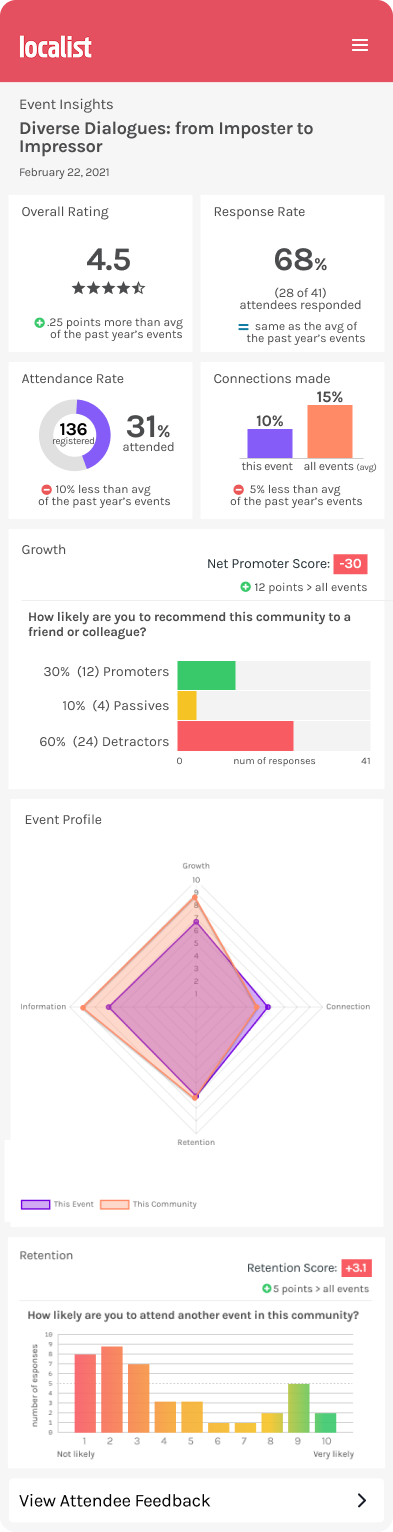
We designed a report that distills attendee feedback into the most meaningful signals, helping customers quickly understand performance and take action.
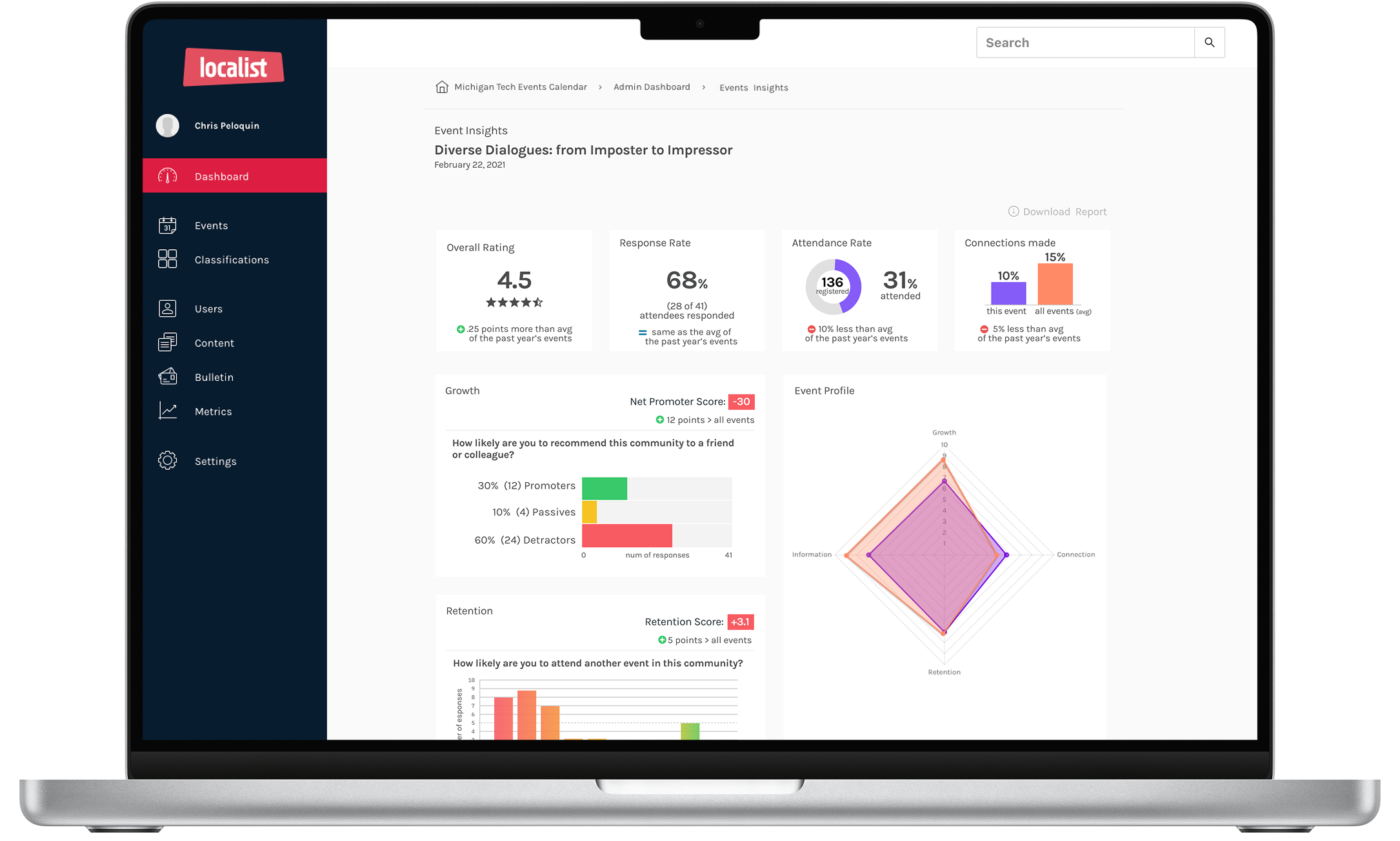
Strategically, this expansion enabled Localist to support enterprise-level conference clients, grow average contract value, and enter new institutional markets.
.svg)
